

Product&Info

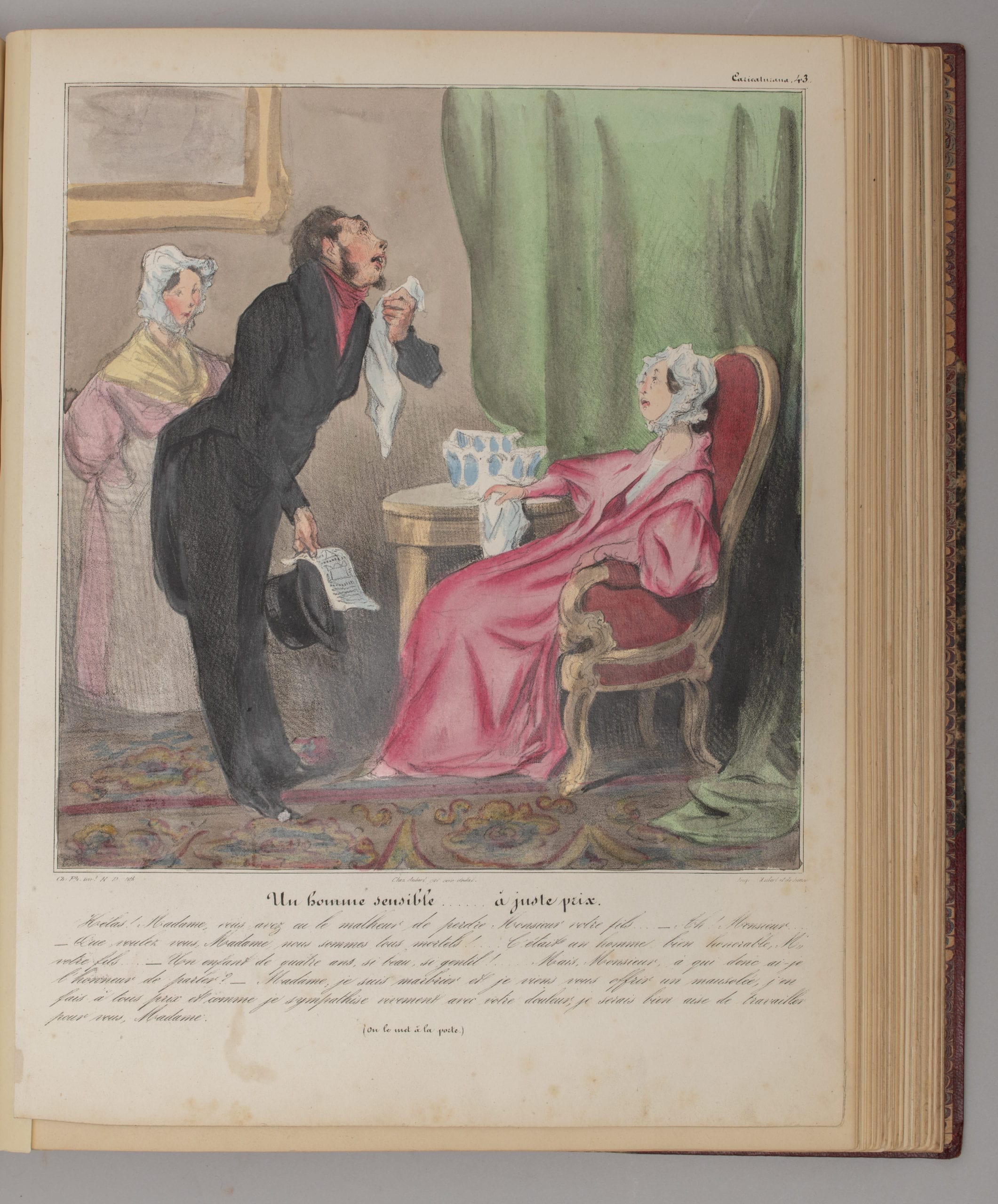
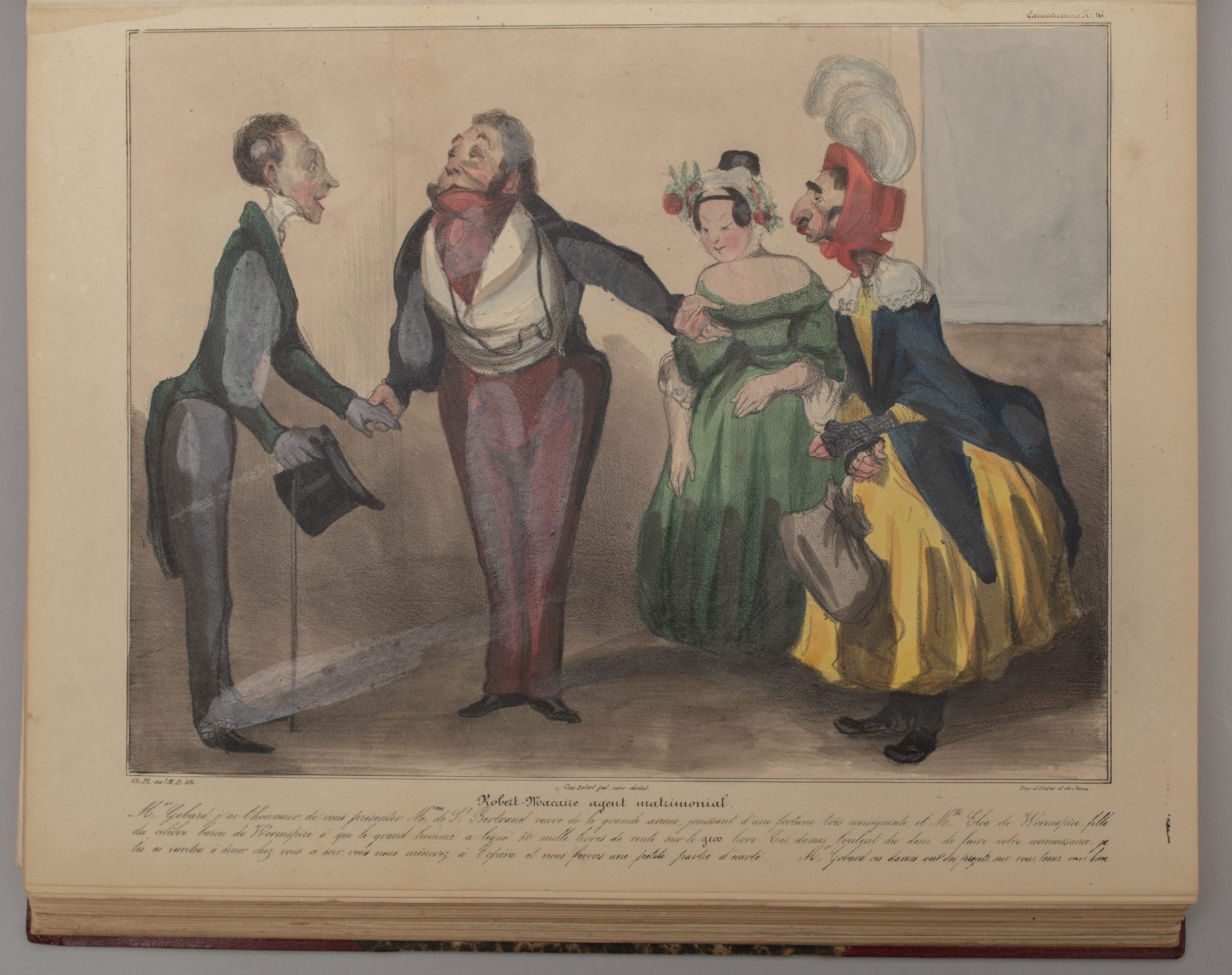
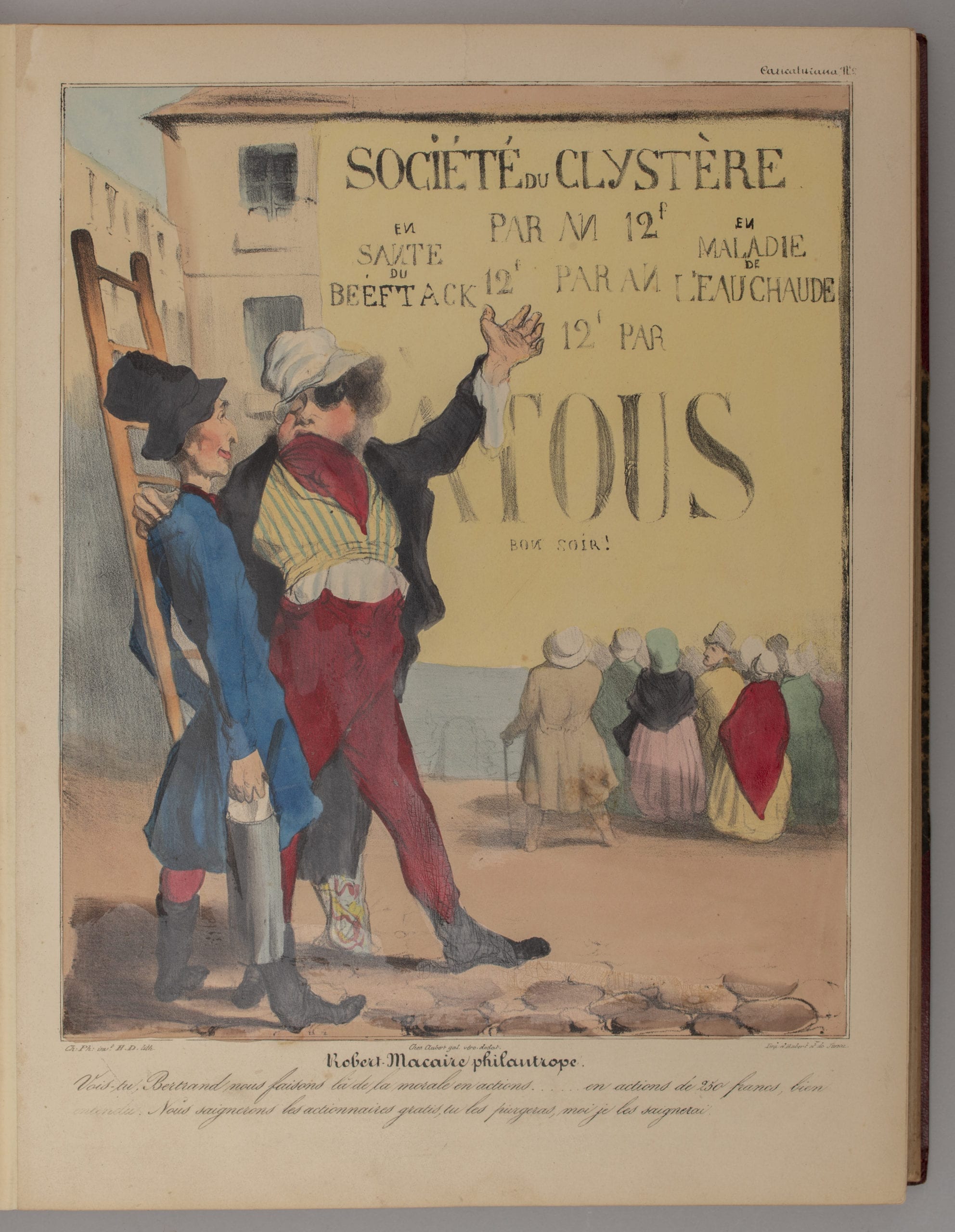

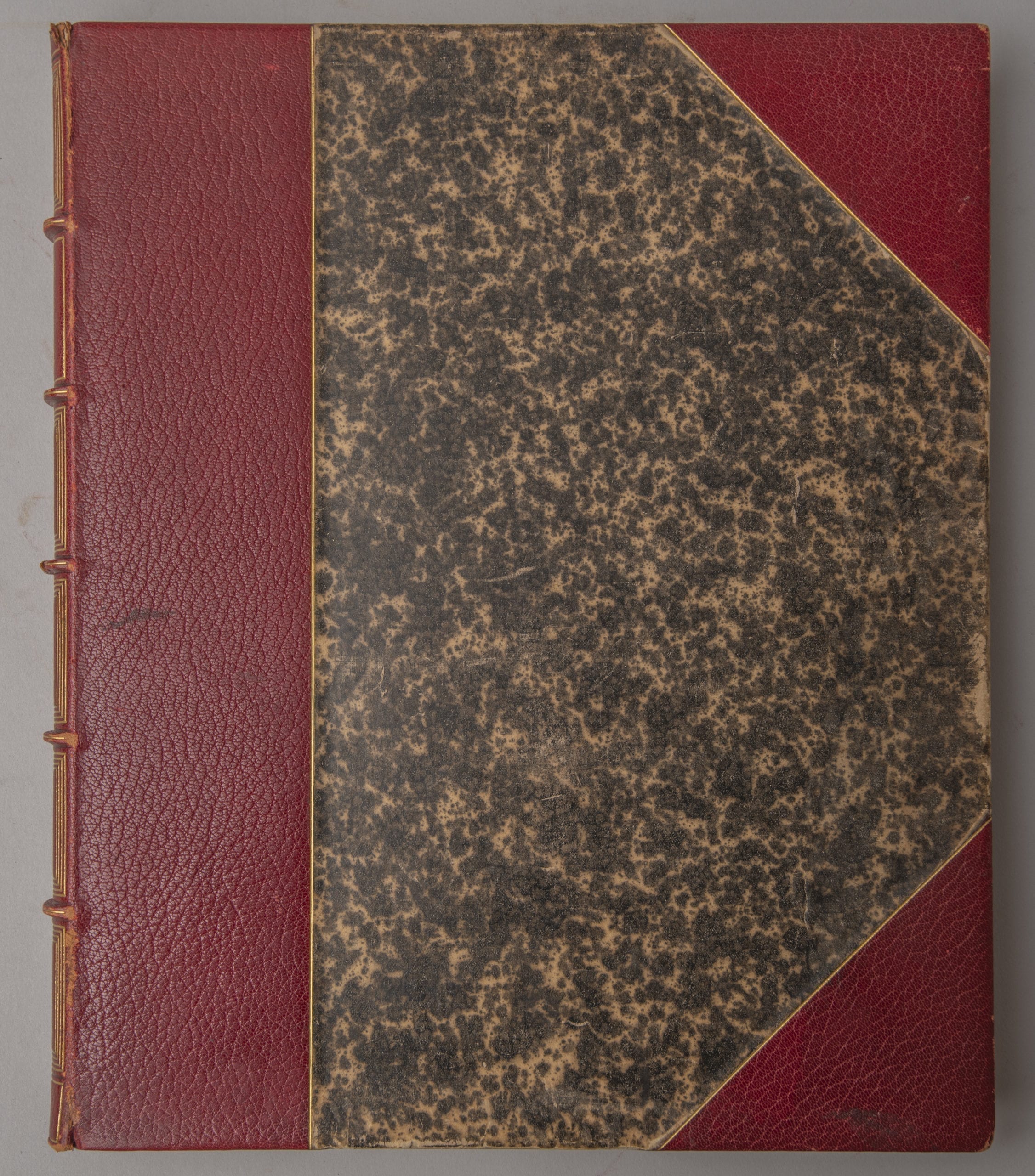
Les Robert Macaires (Caricaturana), par H.Daumier et Ch. Philipon 1836-1838
25.000,00€
Do you need more information about a book?
DAUMIER.- Les Robert Macaires (Caricaturana), par H.Daumier et Ch. Philipon. Galerie Morale des Voleurs, Spéculateurs, Dupeurs, Tireurs, Enfonceurs, Blaguères divers que nous rencontrons dans Paris.
Paris. Chez Aubert (1836-1838).
Folio.- 100 lithographs by Daumier, all with contemporary hand colouring heightened with gum arabic. Red half-morocco, banded spine with title gilt and gilt decoration in six compartments, marbled endpapers.
1st. Edition.
“Je veux parler maintenant de l’un des hommes les plus importants, je nedirai pas seulement de la caricature, mais encore de l’art moderne, d’unhomme qui, tous les matins, divertit la population parisienne, qui, chaque jour, satisfaitaux besoins de la gaieté publique, et lui donne sa pâture. Le bourgeois, l’homme d’affaires, le gamin, la femme, rient et passent souvent, les ingrats! sans regarder le nom. Jusqu’à présent les artistes seul sont compris tout ce qu’il y a de sérieux là-dedans, et que c’est vraiment matière à une étude. On devine qu’ils’agit de Daumier.” Charles Baudlelaire.- Curiosités Esthétiques (1868).
“I want to talk now about one of the most important men, not only in the field of caricature, but also of modern art, a man who, every morning, entertains the people of Paris, who, every day, satisfies the needs of public cheerfulness, and gives it its grazing. The bourgeois, the businessman, the boy, the woman, laugh and often pass by, ungrateful, without looking at his name. …. You can tell he is Daumier.” Charles Baudlelaire.- Curiosités Esthétiques (1868).
Honoré Daumier (1808-1879), painter and sculptor of the artistic and literary movement called Realism, used caricature to formulate a sharp social critique, which earned many problems, even prison in 1832 for presenting King Louis-Philippe of Orleans as Gargantua, the Giant of Rebelais’ novels, with a huge pear-shaped head. Censorship pursued Daumier from then on, forcing him to disguise his political protest by turning to the satire of customs, portraying the social stereotypes of the time, judges, doctors, bankers, merchants, lawyers… highlighting their vices and faults.
“Les Robert Macaires” is his masterpiece in this field. It is a series of lithographs featuring a character from popular comedy, Robert Macaire, an archetype of unscrupulous bourgeois, corrupt and cheater.
The legend of Robert Macaire dates back to the 14th century. It is about a ruffian who commits a murder with no other witnesses than the victim’s dog, which chases him wherever he goes, until the King, in the absence of evidence of the authorship of the murder, decides to settle the issue by a duel between the dog and Robert Macaire with a club. The dog wins and Macaire confesses his crime before dying.
In 1923 Robert Macaire’s character is recovered by the theatrical actor Frédérick Lemaître for the melodrama “L’Auberge des adrets”. The play’s premiere was performed in a serious manner and was not very well received. Lemaitre immediately decided to give it a burlesque and certainly comic tone, portraying Macaire as a robber who decides to enter society by impersonating a respectable but surreptitious character devoted to crime and vice. The success was immediate and the play was constantly performed. In 1834, Lemaitre contacted the authors of “L’auberge des adrets”, Lacoste and Antier, so that they would rewrite the script. Robert Macaire appeared no longer as a bandit but as a high-ranking bourgeois, enriched by swindle, with a social and political speech, calling himself the Knight of San Remondo, a high-flying businessman, director of an insurance company and married to the daughter of a decorated general, who also ended up rebelling as a swindler. The success is again resounding. It is in this context that Daumier, in collaboration with the journalist Phillipon, uses the personage for his series of lithographs in which Macaire appears as the main character of multiple professions, showing when he commits his misdeeds which usually consist of frauds, scams, lies and corruptions.
Daumier provided the drawing and Phillipon, director of the magazines “La Caricature” and “Le Charivari”, the text.
The success among the French of the time was enormous. The lithographs were published in Le Charivari between 1836 and 1838 under the title “Caricaturana”.
Each image was printed on heavy wove paper and was offered uncolored for 45 francs and hand colored for 55 francs.
In 1838 Aubert published the first edition, in the form of an album, with a total print run of 2,500 copies. It was such a success that in 1839 it was published again in two volumes in a smaller format under the title “Les Cent et un Robert Macaire.
The Album edition of 1838, offered here, consists of 100 lithographs, it is exceptionally rare to find a complete set.
This copy contains all 100 lithographs. Number 70 is duplicated, one in its place and another in corresponding number 40, where the original lithograph No. 40 of Caricaturana has also been inserted, with the same format and equally coloured in a contemporary hand.
Fine condition
Additional information
Related products
-

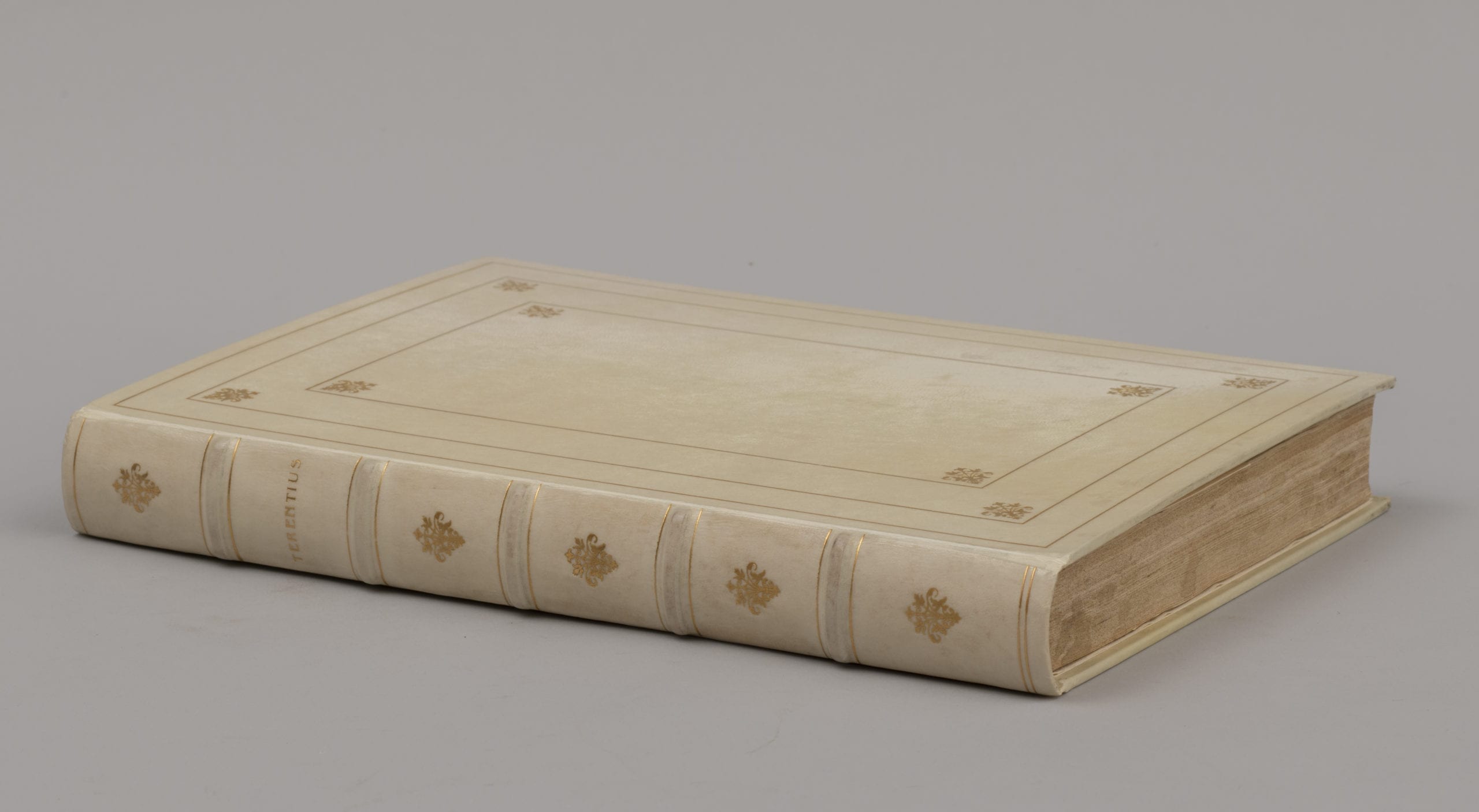
TERENTIUS Cum Tribus Commentis: Videlicet Donati Guidonis Calphurnii. 1497
20.000,00€ -
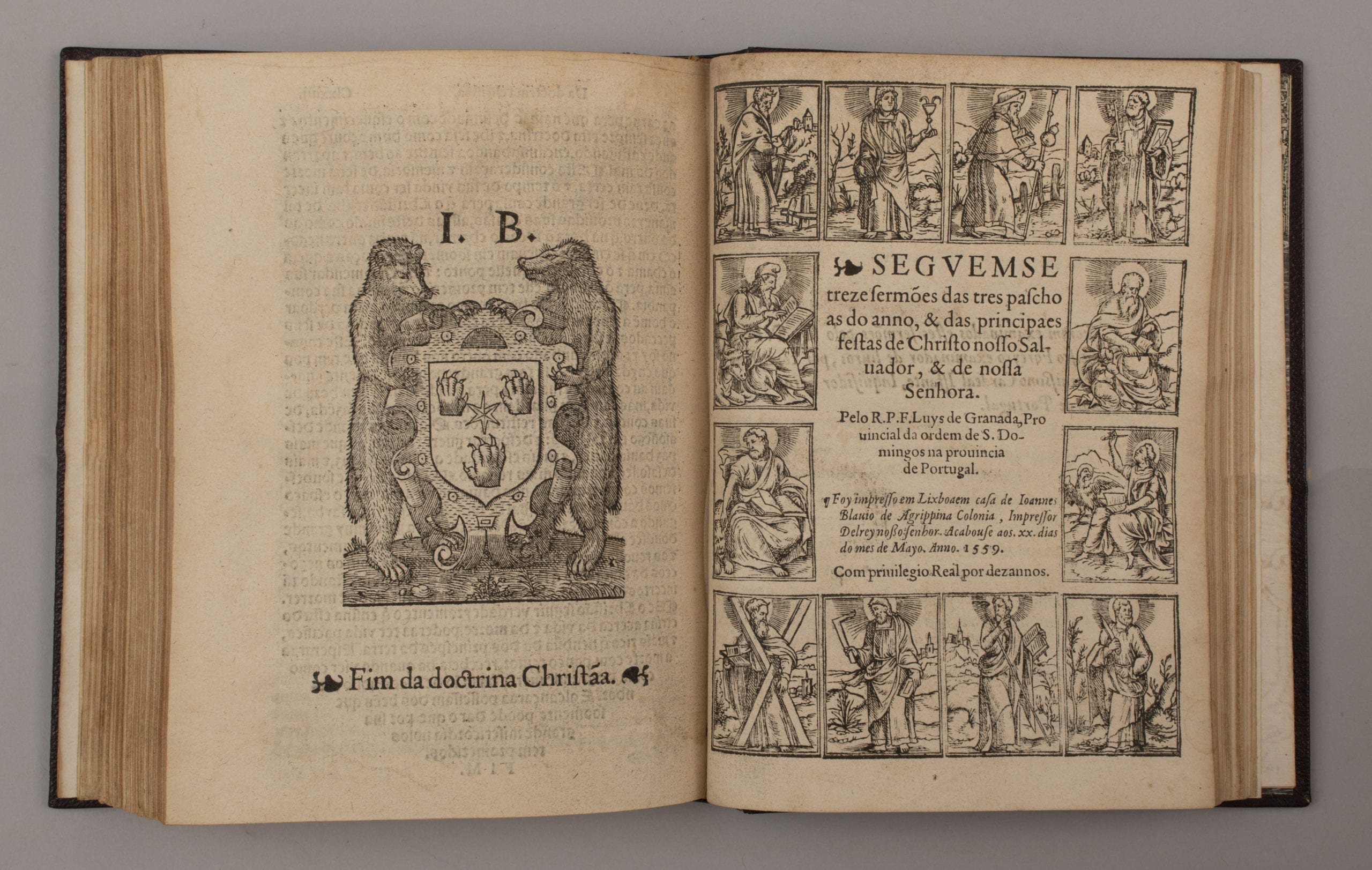
Fray Luis de Granada. Compendio de Doctrina Cristiana. Los Trece Sermones. Lisboa Joannis Blavio 1559.
-
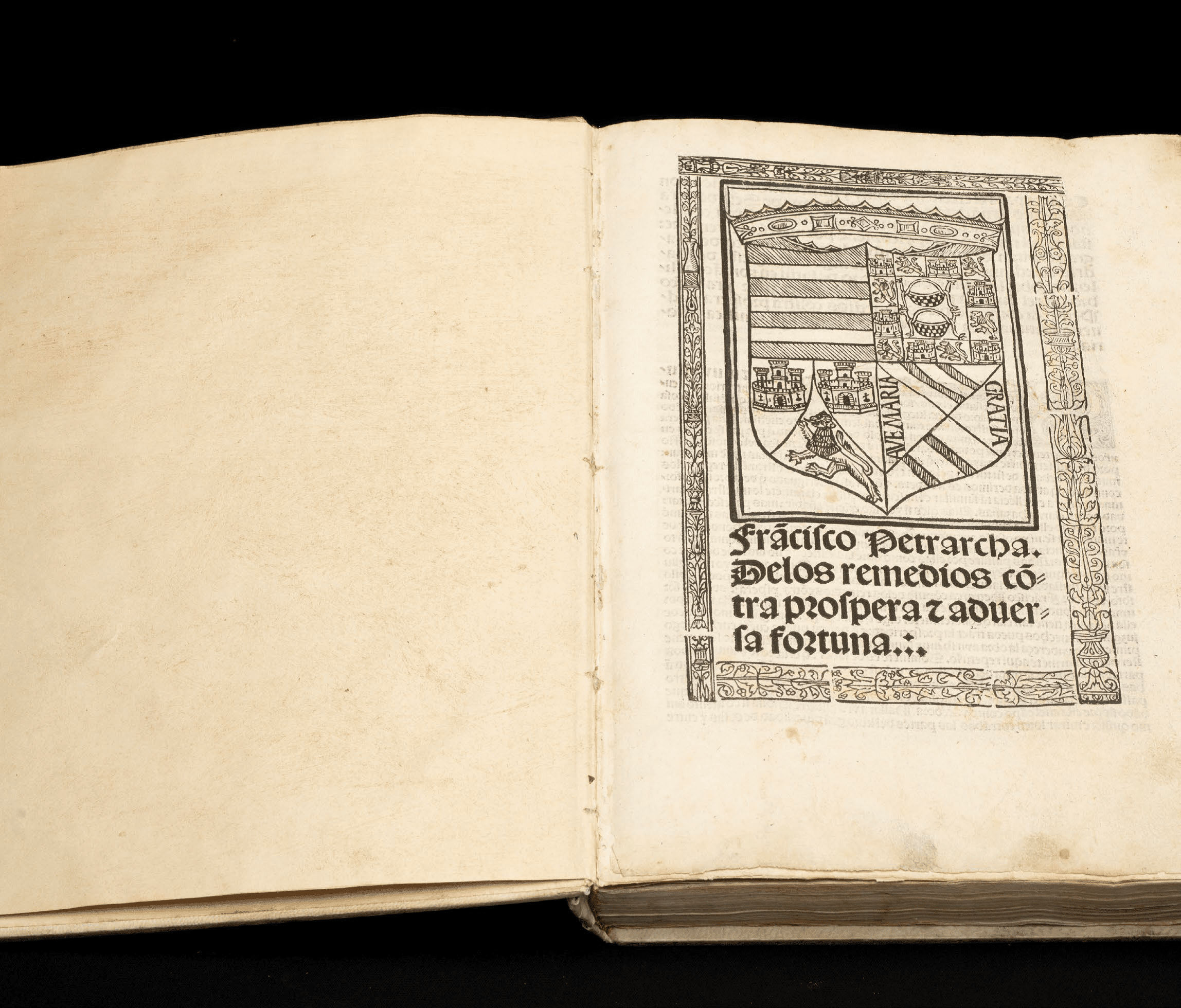
PETRARCA, Francesco.- De los remedios contra próspera y adversa fortuna. 1516
18.000,00€ -
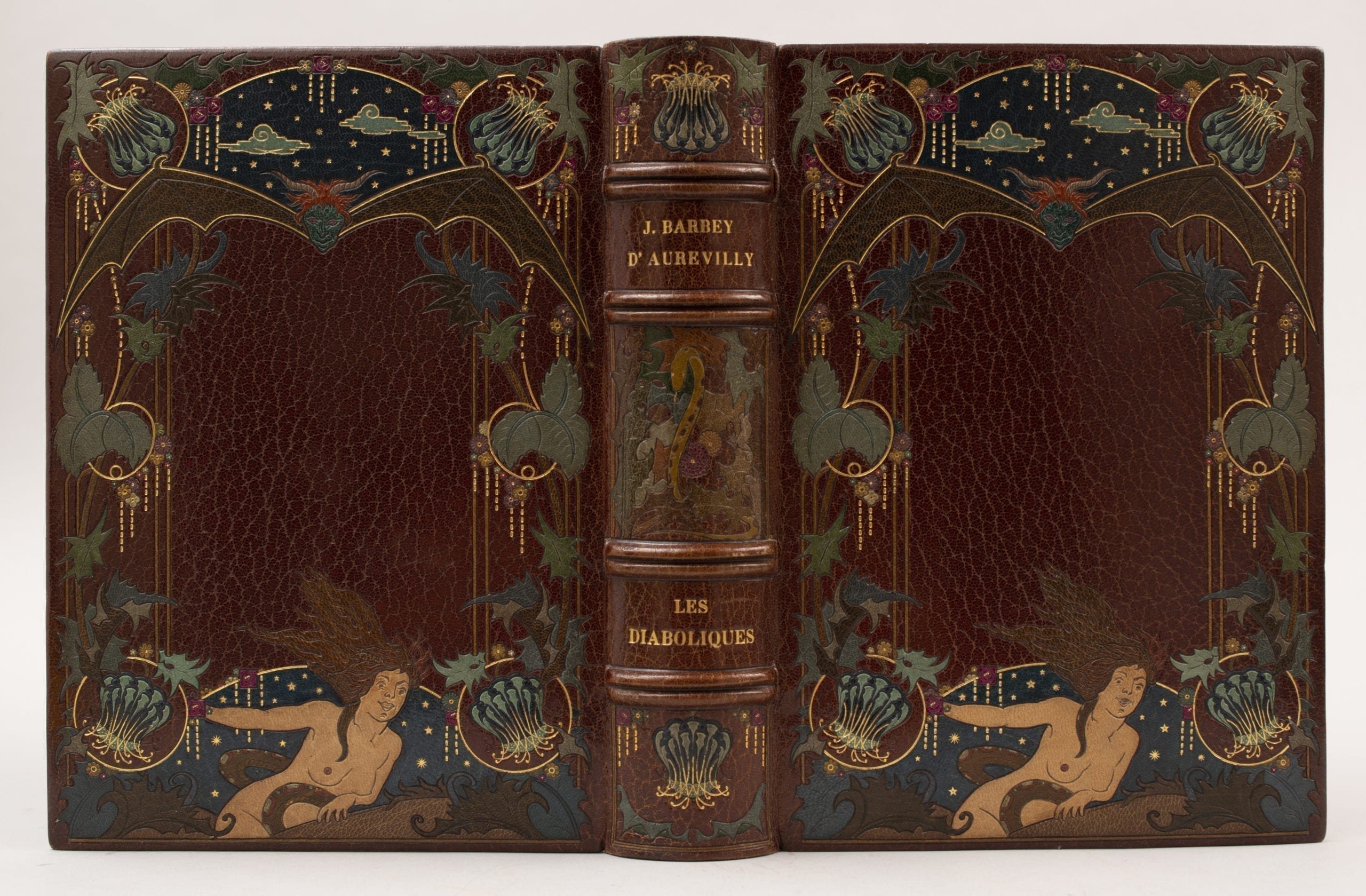
LES DIABOLIQUES. – Barbey D´Aurevilly. Jules & Lobel Riche, Alméry. Paris Octobre 1910. nº 140
15.000,00€
Address
Núñez de Balboa, 54
28001 – Madrid
Social
Contact Us
+34 630885388
balboararebooks@gmail.com
Reviews
There are no reviews yet.