

Product&Info
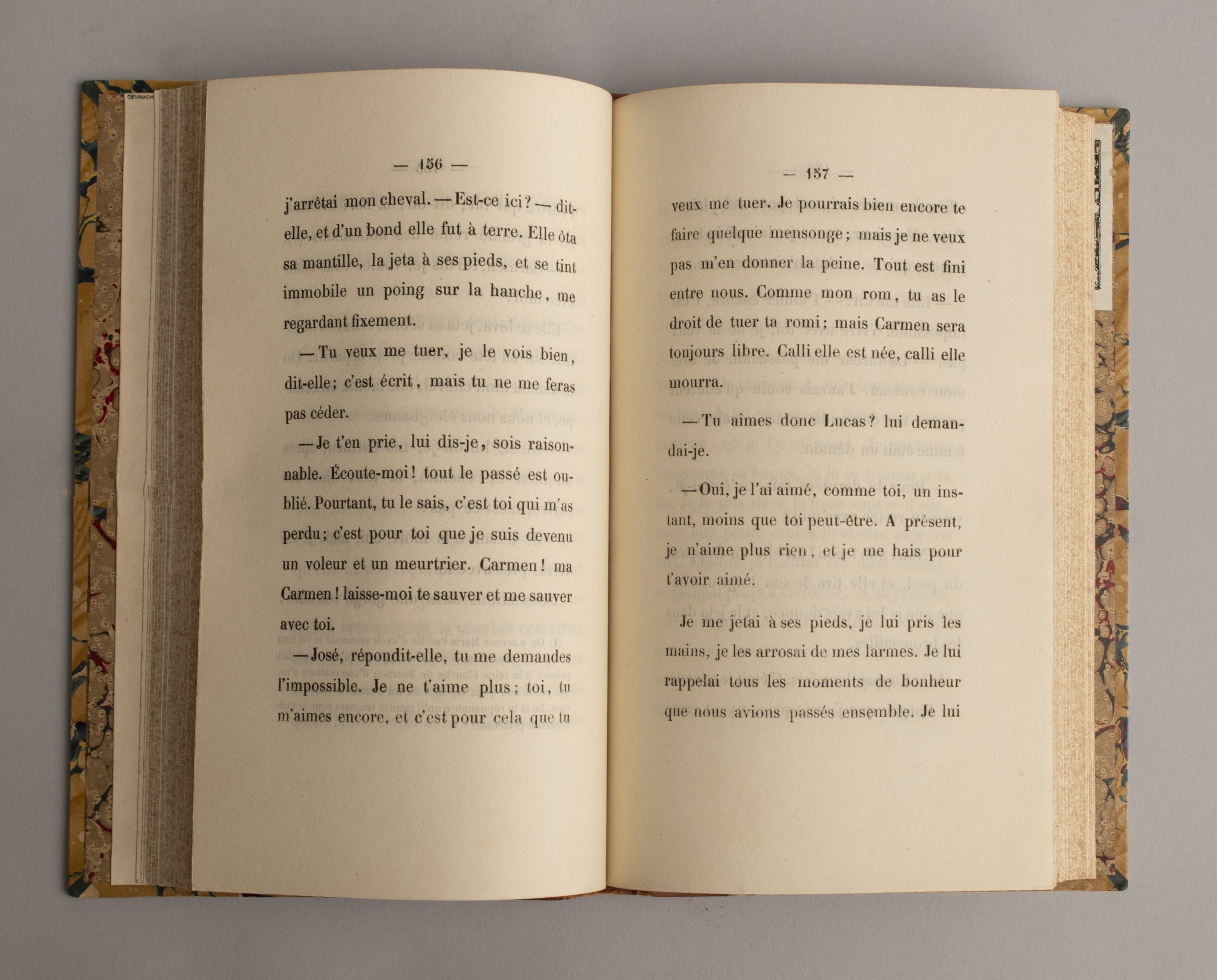
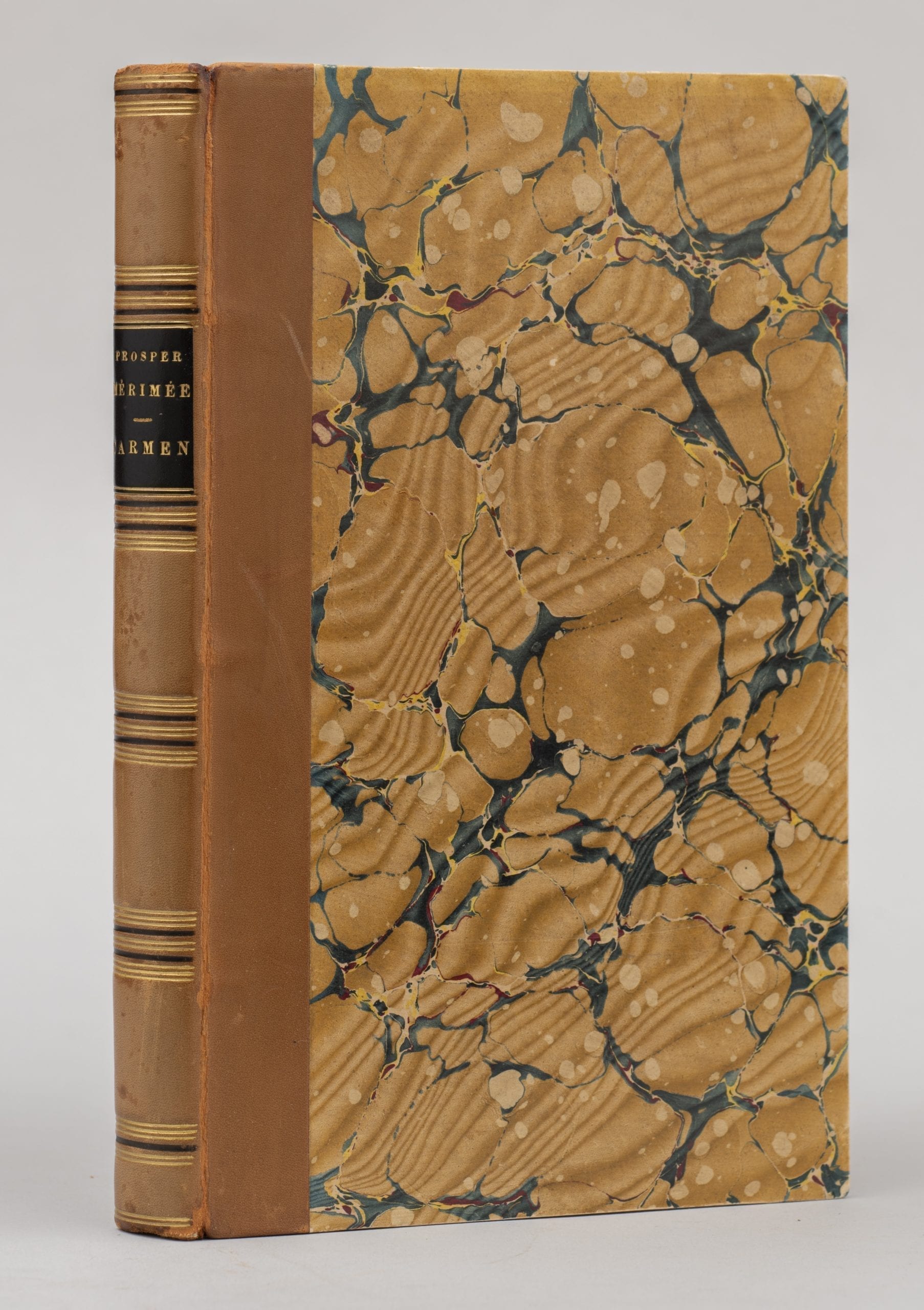
CARMEN. Prosper Mérimée. Michel Lévy Frères. Paris. 1846
5.000,00€
Do you need more information about a book?
“… une beauté étrange et sauvage, une figure qui étonnait d abord, mais qu on ne pouvait oublier. Ses yeux surtout avaient une expression à la fois voluptueuse et farouche que je n ai trouvée depuis à aucun regard humain…”
“…a strange, wild type of beauty, a face that took one by surprise at first, but which one could not forget. Her eyes, especially, had an expression at once voluptuous and fierce, which I have never seen since in a mortal eye… “
Carmen is a short novel set in a mysterious, primitive and exotic Spain, in Andalusia; Its main character is a sensual gypsy that attracts José Navarro, an exemplary and serious soldier turning him into a deserter and a murderer. It combines therefore love, jealousy, passion and death, expressing to perfection the fatality of loving desire and the self-destructive drive that goes with it.
It offers characteristics of three literary movements: Neoclassicism, Romanticism and Realism.
As in many romantic novels the focus shifts from man to woman, reason submits to feelings, and death takes on a relevance that did not have since the end of the middle ages.
The language Merimee uses, however, is more typical of neoclassicism than of romantic writers.
Elements of realism can be appreciated in descriptions of ethnic groups and social classes, with an implicit criticism of social injustice and hypocrisy latent in the bourgeoisie of nineteenth-century Spain, widely studied by Merimee in his travels.
It was first published in 1845, in the Parisian magazine “Revue des Deux Mondes” without the appendix on the customs of the Romany people, which will appear in the first edition in book form, offered here.
It comprises three parts or chapters. The first describes the narrator’s journey through Spain during which he meets D. José, who has become a burglar and deserter; the second chapter refers to the narrator’s meeting with Carmen; and the third and last tells of the tragic fate of both Carmen and José. As said, includes a fourth part that contributes nothing to the plot and describes the origin, language and customs of the gypsy people, as if to justify that the author has a scientific knowledge of Carmen’s ethnicity.
The true success of the story (third chapter) came with the homonymous opera by Georges Bizet, in 1875.
Subsequently, Carmen herself, as a phenotype, turned out to inspire many other works, becoming one of the greatest myths in universal literature.
Prosper Mérimée (Paris in 1803 – Cannes in 1870) pretended to be a painter in his youth, however his father persuaded him for studying law. He finished his degree in law, and during his studies his passion for literature began. He published his first play in 1825, Théâtre de Clara Gazul, of important success. His second publication, The Gusle, in 1827, included a collection of Italian folk songs, which were in fact Mérimée’s own composition. The immense success of the ballads led to their translation into German and Russian. His masterpieces, however, arrived some time later: Colomba (1840) and Carmen (1845).
He was a passionate student of architecture, archaeology and foreign languages, translating works of Pushkin and Gogol, claiming for that reason so much the honor of having introduced Russian literature into France.
Octavo mayor (21.5 x 13.5), pp. [5] 2-363 [3]. XXth century binding by famous French binder DEVAUCHELLE. Fine condition. First edition extremely rare and very sought
Additional information
| Ano |
|---|
Additional information
| Ano |
|---|
Address
Núñez de Balboa, 54
28001 – Madrid
Social
Contact Us
+34 630885388
balboararebooks@gmail.com
Reviews
There are no reviews yet.